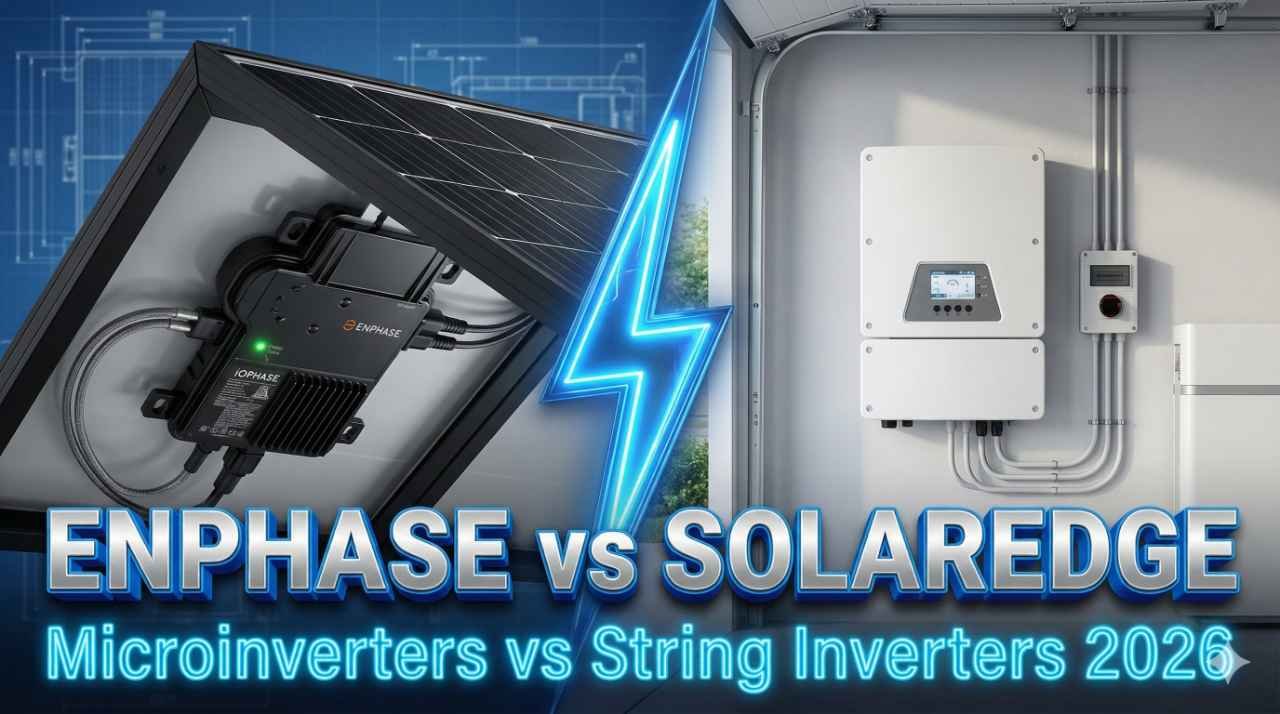
Enphase vs. SolarEdge: The Ultimate Inverter Showdown (2026)
When you buy a solar system, you aren’t just buying panels; you are buying an Inverter. This is the “brain” of your system, converting the sun’s DC energy into usable AC electricity for your home.
In the US market, two giants dominate the industry: Enphase (Microinverters) and SolarEdge (String Inverters with Optimizers).
Choosing the wrong one can cost you thousands in lost efficiency or future repair bills. In this detailed 2026 comparison, we break down the pros, cons, and costs of each to help you decide.
1. What is the Difference?
Enphase (Microinverters):
- Technology: A small inverter is attached underneath each solar panel.
- How it works: Each panel converts electricity independently. If one panel is shaded, the others keep working at 100%.
- Key Model: Enphase IQ8 Series.
SolarEdge (String Inverter + Power Optimizers):
- Technology: A central inverter is mounted on the side of your house, connected to all panels via “strings.”
- How it works: Small “Optimizers” are on the panels to manage shade, but the actual conversion happens at the main wall unit.
- Key Model: SolarEdge Home Hub Inverter.
2. Performance in Shade (The “Tree” Test)
- Enphase (Winner): Because every panel is its own power plant, Enphase is the king of complex roofs. If a tree casts a shadow on 3 panels, the other 17 panels are completely unaffected.
- SolarEdge (Runner Up): SolarEdge uses “Power Optimizers” to mitigate shading issues better than old-school string inverters. However, if the main central inverter fails, the entire system shuts down.
3. Reliability & Warranty
This is where the biggest difference lies.
- Enphase: Comes with a standard 25-year warranty. Since there is no single point of failure, even if one microinverter dies, the rest of your system keeps running.
- SolarEdge: The optimizers have a 25-year warranty, BUT the central inverter usually has a 12-year standard warranty (extendable to 25 for a fee). Central inverters work harder and often fail after 10-15 years.
4. Cost Comparison
- SolarEdge: Typically cheaper. For a standard 10kW system, choosing SolarEdge can save you $1,000 – $2,000 upfront compared to Enphase.
- Enphase: More expensive due to the complex hardware required for every single panel.
5. Battery Integration
- SolarEdge (Winner): SolarEdge offers “DC Coupling,” which is slightly more efficient when charging a battery (like the LG Chem or SolarEdge Home Battery). You lose less energy during the transfer.
- Enphase: Uses “AC Coupling.” While the Enphase IQ Battery 5P is fantastic and reliable, the conversion process is slightly less efficient than a DC-coupled system.
Conclusion: Which One Should You Buy?
- Choose Enphase IF: You have a roof with multiple angles or shade from trees, and you want the peace of mind of a 25-year warranty. It is the premium, “worry-free” choice.
- Choose SolarEdge IF: You have a simple, south-facing roof with no shade, you are on a budget, or you plan to install a large battery system and want maximum charging efficiency.
Our Verdict for 2026: For most residential homeowners, Enphase is worth the extra cost for its reliability. For larger or commercial systems, SolarEdge offers better value.
Frequently Asked Questions (FAQs)
Q1: Can I expand my system later? Enphase: Yes, very easily. You can add just one or two panels later. SolarEdge: It is harder. You are limited by the capacity of your central inverter. You might need to buy a whole new inverter to add more panels.
Q2: Which one is safer? Enphase is generally considered safer because it converts high-voltage DC to standard AC right on the roof. SolarEdge runs high-voltage DC across your roof to the side of the house (though their “SafeDC” technology mitigates risks).
Q3: Does Tesla use Enphase or SolarEdge? Tesla now uses their own proprietary Tesla Solar Inverter, which is a string inverter similar to SolarEdge but without the optimizers.