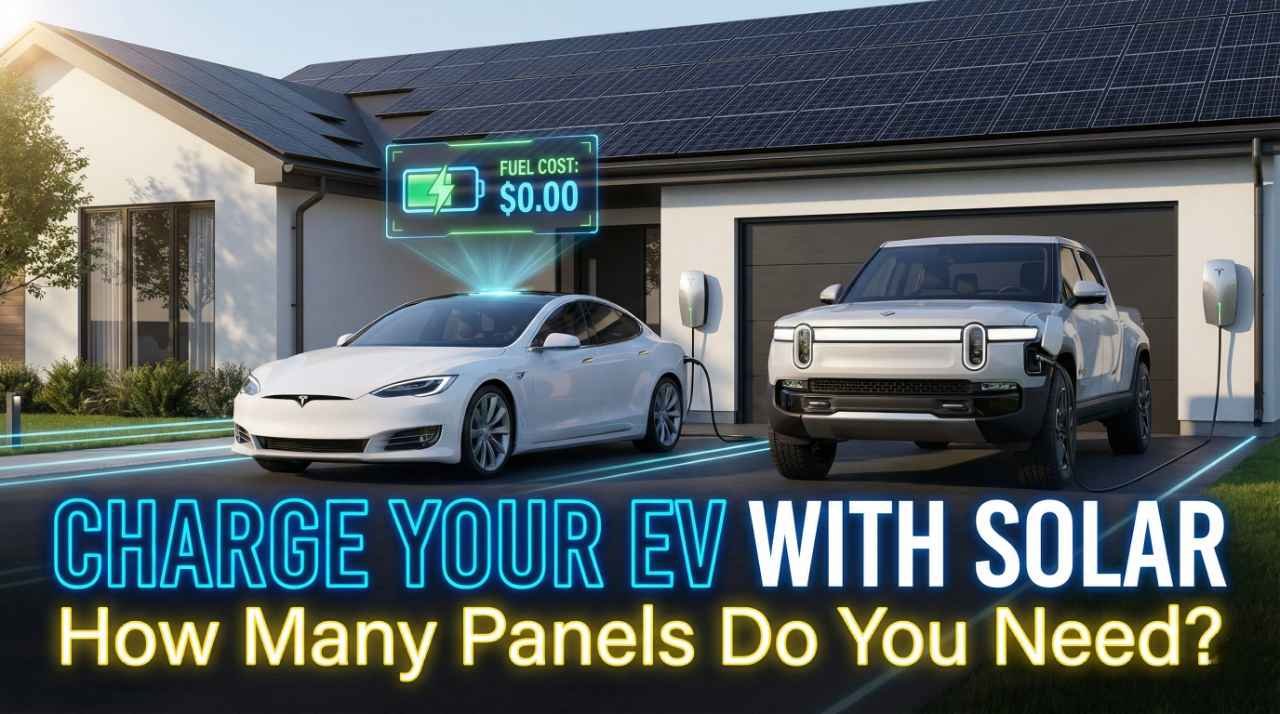
Charging Your EV with Solar Panels: The Ultimate “Zero Fuel” Guide (2026)
Imagine never paying for gas again. Now, imagine never paying the electric company to charge your car either.
Combining Solar Panels with an Electric Vehicle (EV) is the ultimate financial hack in 2026. It allows you to create your own “gas station” on your roof. But how does it work, and is a standard solar system big enough to power both your house and your car?
In this guide, we do the math to help you figure out how many extra panels you need to drive on sunshine.
1. The Math: How Much Power Does an EV Need?
To figure out how many solar panels you need, we first need to know how much electricity your car drinks.
- Average EV Efficiency: Most EVs (like the Tesla Model 3 or Model Y) use about 30 kWh for every 100 miles driven.
- Average Mileage: The average American drives roughly 13,500 miles per year (approx. 37 miles per day).
- Annual Energy Needed: 13,500 miles ÷ 3.3 miles/kWh = ~4,100 kWh per year.
So, your solar system needs to produce an extra 4,100 kWh per year just for the car.
2. How Many Solar Panels is That?
In 2026, a standard solar panel produces about 400 watts of power. Depending on where you live (sunny California vs. cloudy Seattle), a single panel produces between 1.3 to 1.6 kWh per day.
- Calculation: 4,100 kWh (needed) ÷ 550 kWh (average annual production per panel) = ~7.5 Panels.
Verdict: You typically need 8 to 10 extra solar panels to power an EV for average daily driving.
3. The Cost Savings: Gas vs. Grid vs. Solar
Let’s look at the “fuel” cost for driving 13,500 miles:
- Gas Car (30 MPG @ $3.50/gal): Cost = $1,575 / year.
- EV using Grid Power (Avg $0.16/kWh): Cost = $656 / year.
- EV using Solar Power (Levelized Cost $0.06/kWh): Cost = $246 / year.
Result: Switching from Gas to Solar-Charged EV saves you over $1,300 every year. Over the 25-year life of the panels, that is $32,500 in savings!
4. Best EV Chargers for Solar Users
Not all chargers are created equal. In 2026, “Smart Chargers” can sync with your solar panels to ensure you are only charging with excess sunshine, not expensive grid power.
- Enphase IQ EV Charger: This integrates perfectly with the Enphase app. You can set a “Sunlight Only” mode to charge your car using only the extra energy your roof produces.
- SolarEdge EV Charger: Similar to Enphase, it allows you to charge up to 25% faster by using both solar and grid power simultaneously.
- Tesla Wall Connector: The standard for Tesla owners. While it doesn’t have a specific “solar-only” mode without Powerwall, it is the most reliable and affordable option.
5. Do You Need a Battery?
This is the catch. Most people charge their cars at night when they get home from work. But solar panels only work during the day.
If you don’t have a home battery (like a Powerwall), you will technically be charging your car from the grid at night.
- The Fix: Use Net Metering. Send your solar power to the grid during the day (earning credits) and use those credits to pull power back from the grid at night to charge your car.
Conclusion
If you are buying an EV in 2026, you should absolutely consider adding 8-10 extra panels to your solar installation. It turns your car into a virtually free mode of transportation and protects you from rising gas and electricity prices forever.
Frequently Asked Questions (FAQs)
Q1: Can I charge my EV directly from solar panels without the grid? Generally, no. Solar production fluctuates with clouds. You need the grid (or a battery) to provide a steady stream of power to the car charger.
Q2: How much does it cost to add 10 panels? Adding 10 panels (approx 4kW) to a system typically costs between $8,000 and $10,000 before the 30% tax credit.
Q3: Will charging my EV slow down my home WiFi? No, but it will increase your home’s total energy consumption significantly. Ensure your main electrical panel (breaker box) can handle the load (usually 200 Amps is recommended).