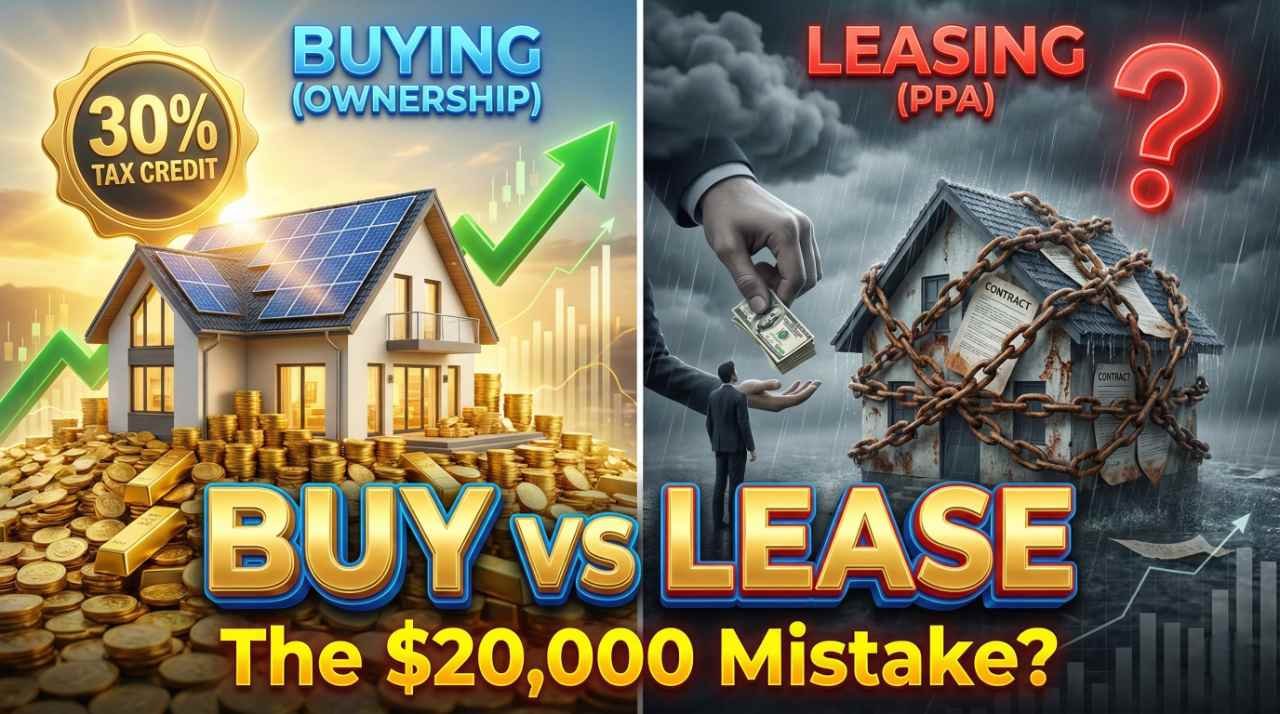
Buying vs. Leasing Solar Panels in 2026: Don’t Sign Until You Read This
“Go solar for $0 down!” – You have probably seen this advertisement everywhere. While it sounds tempting, the method you choose to finance your solar system can mean the difference between saving **$30,000** or saving just $3,000 over the life of the system.
In 2026, homeowners generally have three options: Cash Purchase, Solar Loan, or a Solar Lease/PPA.
Which one is right for you? In this guide, we expose the pros and cons of each to help you avoid the “leasing trap.”
Option 1: Cash Purchase (The Maximum ROI)
Paying cash is the simplest and most profitable way to go solar. You pay for the system upfront, and you own 100% of the electricity it produces from Day 1.
- Pros:
- You get the 30% Federal Tax Credit immediately.
- No interest payments to a bank.
- Your home value increases instantly (by ~4%).
- Highest lifetime savings (ROI).
- Cons: Requires a large upfront investment ($15,000 – $25,000).
Option 2: Solar Loan (Ownership with Payments)
Most Americans choose this option. You take out a loan (specifically a “Solar Loan” or a Home Equity Line of Credit) to pay for the system.
- Pros:
- $0 Down: Many loans require no money upfront.
- You still own the system: Meaning you still get to claim the 30% Tax Credit.
- Monthly payments are often lower than your old electricity bill.
- Cons: Interest rates in 2026 can be high, and “Dealer Fees” (hidden origination fees) can add 15-25% to the total loan amount.
Option 3: Solar Lease / PPA (Power Purchase Agreement)
This is the “Free Solar” marketing pitch. Here, a solar company (like Sunrun or Sunnova) installs panels on your roof for free. You do not own them. Instead, you agree to buy the power they produce at a set rate.
- Pros:
- Absolutely $0 out of pocket.
- The company handles all maintenance and repairs.
- Cons (The Deal Breakers):
- No Tax Credit: The solar company keeps the 30% credit, not you.
- Low Savings: You might save only 10-15% on bills compared to 90-100% with ownership.
- Selling Your Home is a Nightmare: If you try to sell your house, the new buyer must agree to take over your solar lease. Many buyers refuse, forcing you to pay thousands to break the contract.
Comparison Table: Buy vs. Lease
| Feature | Cash / Loan (Buying) | PPA / Lease (Renting) |
| Upfront Cost | High (Cash) or $0 (Loan) | $0 |
| 30% Tax Credit | You keep it | Company keeps it |
| Home Value | Increases (~4%) | No Increase (Neutral/Negative) |
| Maintenance | Your Responsibility (under warranty) | Company’s Responsibility |
| 25-Year Savings | **$25,000 – $40,000+** | $3,000 – $8,000 |
The Verdict for 2026
If you pay federal income taxes and qualify for a loan, Buying (or Financing) is almost always better than Leasing.
Leasing only makes sense if:
- You do not have enough tax liability to use the 30% Federal Tax Credit (e.g., retired seniors with low income).
- You don’t want to take out a loan or use savings.
Conclusion
Don’t let a salesperson pressure you into a PPA just because it’s “$0 down.” A Solar Loan is also $0 down, but it allows you to build equity, claim tax incentives, and sell your home easily in the future.
Frequently Asked Questions (FAQs)
Q1: What happens if I sell my house with a solar lease?
You have to transfer the lease to the new homebuyer. If they don’t qualify for the lease or don’t want it, you may have to buy out the remainder of the contract (which can cost $20,000+) to close the sale.
Q2: Are solar loan payments tax-deductible?
If you use a Home Equity Loan (HELOC) to buy solar, the interest may be tax-deductible. Standard solar loan interest is usually not deductible. Consult a tax pro.
Q3: Can I buy the system after leasing it?
Most leases have a “buyout option” after 5 or 7 years, but the price is usually determined by the solar company and may be higher than fair market value.