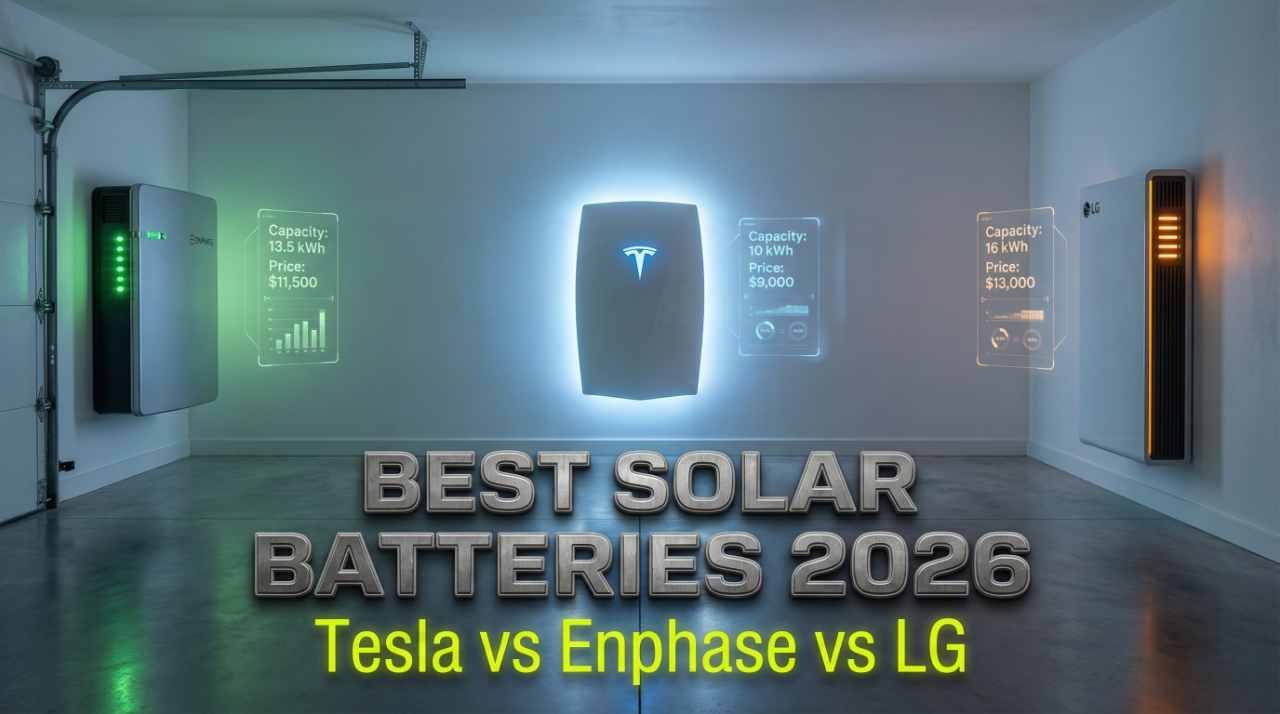
Best Solar Batteries of 2026: Which One Should You Buy?
As power outages become more frequent and utility companies shift to “Time-of-Use” rates, solar panels alone are no longer enough for many US homeowners. You need a battery to store that energy.
In 2026, the home energy storage market is more competitive than ever. But with options like the Tesla Powerwall 3, Enphase IQ Battery, and LG RESU, how do you choose?
In this comprehensive review, we compare the top solar batteries of 2026 based on price, capacity, and technology to help you decide.
1. Why Do You Need a Solar Battery?
Before looking at brands, it’s important to understand why you are buying one.
- Backup Power: Keep your lights, fridge, and WiFi running during a blackout.
- Time-of-Use (TOU) Arbitrage: Store free solar energy during the day and use it at night when grid electricity rates are highest.
- Off-Grid Capability: Become completely independent from your utility provider.
2. Tesla Powerwall 3: The Market Leader
The Tesla Powerwall remains the most popular choice in 2026 due to its brand recognition and integrated inverter technology.
- Capacity: 13.5 kWh
- Continuous Power: 11.5 kW (High output)
- Estimated Cost: $12,000 – $16,000 (Installed)
- Pros: It has a built-in solar inverter, meaning you don’t need to buy separate equipment. It looks sleek and has the best app interface.
- Cons: Customer service can be slow, and there are often waitlists for installation.
3. Enphase IQ Battery 5P: The Modular Choice
If you already have Enphase microinverters on your roof, the Enphase IQ Battery 5P is likely your best option. It is a modular system, meaning you can stack multiple small batteries to get the exact size you need.
- Capacity: 5 kWh per unit (Stackable)
- Continuous Power: 3.84 kW per unit
- Estimated Cost: $4,000 – $5,000 per unit (Installed)
- Pros: Extremely safe (LFP chemistry), reliable, and works seamlessly with Enphase solar systems.
- Cons: Slightly more expensive per kWh than Tesla if you are building a large system.
4. LG Energy Solution RESU: The Compact Powerhouse
LG has updated its RESU line in 2026 to compete with Tesla. It is a favorite among third-party installers like Sunrun and SunPower.
- Capacity: 9.6 kWh – 16 kWh options
- Estimated Cost: $11,000 – $15,000 (Installed)
- Pros: Compact size and widely available through many local installers.
- Cons: Requires a separate inverter (unlike the Powerwall 3), which can add to the installation complexity.
5. FranklinWH: The Dark Horse
A newer competitor that is gaining traction in 2026 is FranklinWH. Their “aPower” battery is praised for its ability to manage heavy loads, like air conditioners, without tripping the system. It is often considered the most “installer-friendly” battery.
Conclusion: Which Battery is Right for You?
- Choose Tesla Powerwall 3 if: You are installing a brand new solar system and want an all-in-one solution with high power output.
- Choose Enphase IQ if: You already have Enphase microinverters on your roof and want a safe, modular upgrade.
- Choose FranklinWH if: You need to back up heavy appliances like AC units and pumps during grid failures.
Don’t forget: The 30% Federal Tax Credit applies to battery storage as well, even if you install the battery separately from the solar panels!
Frequently Asked Questions (FAQs)
Q1: How long will a solar battery run my house? A single 13.5 kWh battery typically runs essential appliances (lights, fridge, WiFi) for 12 to 24 hours. To run AC or heat, you will need 2 or 3 batteries.
Q2: Can I add a battery to my existing solar panels? Yes! This is called “AC Coupling.” Enphase and Tesla batteries work well for retrofitting existing solar systems.
Q3: What is the lifespan of a solar battery? Most solar batteries in 2026 come with a 10-year warranty, but they generally last 15 years before their capacity degrades significantly.