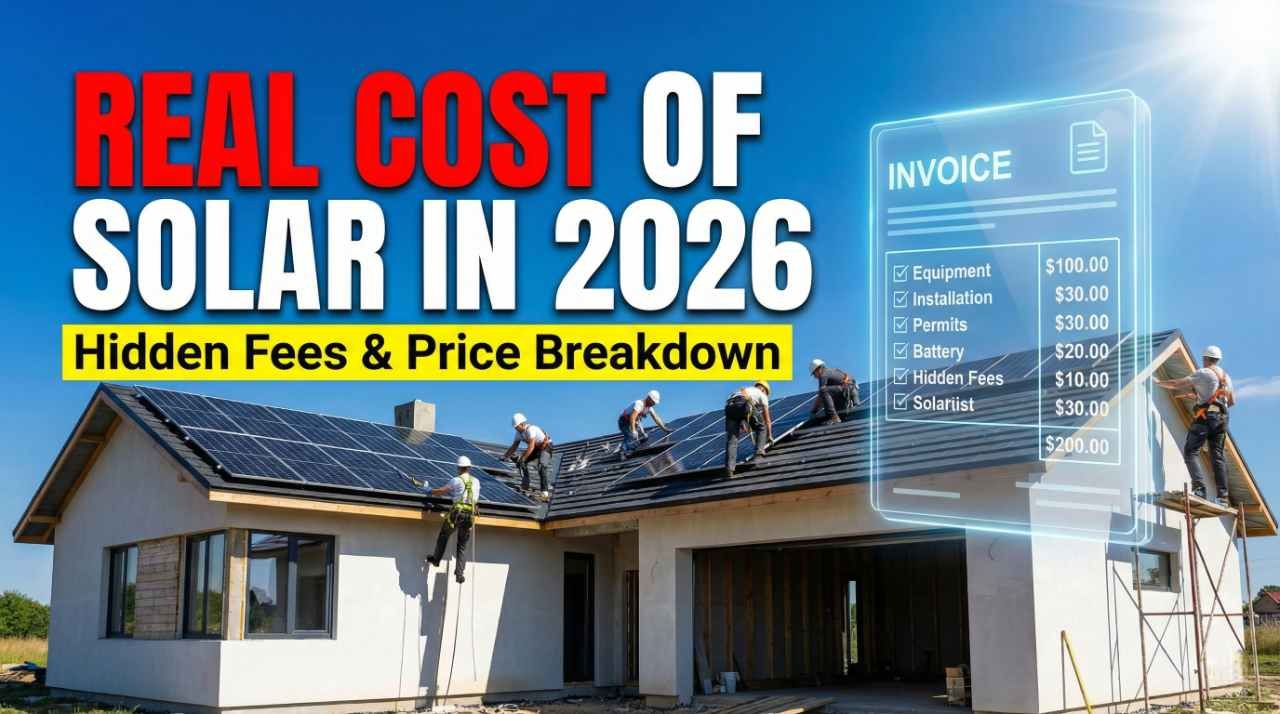
2026 Solar Panel Cost Breakdown: What Are You Really Paying For?
If you are reading this, you are probably ready to go solar but are confused by the price tags. One quote says $15,000, while another says $35,000. Why is there such a huge difference?
In 2026, the average cost of solar in the United States has stabilized, but “soft costs” and hidden fees can catch homeowners off guard. Understanding exactly where your money goes is the key to negotiating a better deal.
In this guide, we break down the real cost of solar installation, separating the hardware from the hidden fees.
1. The Average Cost Per Watt in 2026
The industry standard for pricing solar is “Price Per Watt” (PPW).
- Average PPW: $2.60 – $3.40 per watt.
- Average System Size: 6kW – 10kW.
- Total Average Cost: $18,000 – $28,000 (before incentives).
If a company quotes you significantly higher than $3.50/watt for a standard rooftop system without batteries, you might be overpaying.
2. Hardware Costs (Only 40% of the Price)
Surprisingly, the actual solar panels and equipment only make up about 40-45% of the total bill.
- Solar Panels: Tier-1 brands like REC, Maxeon, or Qcells cost more but last longer.
- Inverters: This is the heart of your system. String inverters are cheaper, while Microinverters (like Enphase) or Optimizers (SolarEdge) cost more but offer better efficiency in shady areas.
- Racking & Mounting: The aluminum rails that hold the panels to your roof.
3. Soft Costs & Labor (The Hidden 60%)
This is where the money really goes. “Soft costs” refer to non-hardware expenses, and they are the main reason US solar is more expensive than in Australia or Germany.
- Permitting & Inspection Fees: Local governments charge fees to review your plans.
- Sales & Marketing: A significant chunk of your bill pays for the salesperson’s commission.
- Installation Labor: Paying for certified electricians and roofers.
- Interconnection Fees: The cost to connect your system to the utility grid.
4. Hidden Fees to Watch Out For
Before signing a contract, ask your installer about these potential extra charges:
- Main Panel Upgrade ($1,500 – $3,000): If your home’s electrical panel is old (100 Amps or less), you may need an upgrade to handle solar.
- Roof Repair: Solar panels cannot be installed on a damaged roof. If your roof needs replacing, that is a separate cost (though sometimes bundled for financing).
- Dealer Fees (For Solar Loans): If you are financing with a low-interest rate (e.g., 3.99%), the lender often adds a “Dealer Fee” of 15-25% to the total loan amount. Always ask for the cash price first!
5. Reducing the Cost: The 30% Tax Credit
Remember, whatever the final sticker price is, the Federal Investment Tax Credit (ITC) covers 30% of it.
- Scenario:
- System Cost: $25,000
- Main Panel Upgrade: $2,000
- Total Project Cost: $27,000
- 30% Tax Credit: -$8,100
- Net Cost: $18,900
Conclusion: Get the Cash Price
To ensure you aren’t paying hidden financing fees, always ask installers: “What is the cash price per watt?” This strips away the dealer fees and allows you to compare quotes apples-to-apples.
We recommend getting at least three quotes from local installers rather than just big national chains to find the best balance of price and service.
Frequently Asked Questions (FAQs)
Q1: Why is my solar quote so expensive? You might be seeing “Dealer Fees” included in the loan. These fees buy down the interest rate but increase the upfront balance.
Q2: Is a battery included in the installation cost? Usually, no. Adding a battery (like a Tesla Powerwall) adds another $10,000 to $15,000 to the total project cost.
Q3: Can I install solar panels myself to save money? DIY solar can save 50% of the cost, but it is dangerous, complicated, and you may void roof warranties or miss out on utility rebates.